


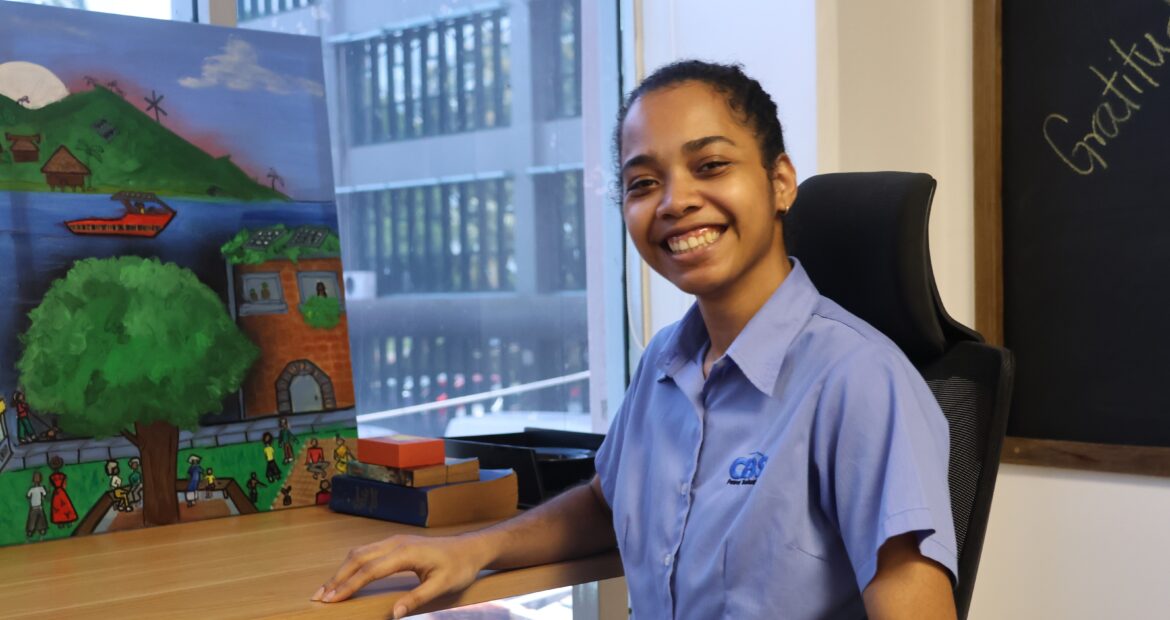
On the lush, volcanic island of Koro, in Fiji’s Lomaviti Group, Timaima Marica learned from an early age how things worked, and what life without reliable energy access was like.
“My grandpa took me everywhere with him; farming, and helping him build and fix things. I would pull things apart just to see how they worked.
“He would get upset, but then say, okay, put it back together,” she laughs.
Across Fiji’s last nautical mile communities, people plan their day around power; when will the power come on to complete the family laundry, or for cooking dinner, or for kids completing their homework.
For Timaima, who now works as an electrical engineer, the extension of reliable, solar power to rural and maritime communities is being made possible via the Fiji Rural Electrification Fund (FREF) Project. This work supported by the United Nations Development Programme (UNDP) and the Government of Fiji.
Her work is part of this wider effort to overcome the challenges of distance, geography and cost that have long kept reliable electricity access out of reach for so many of Fiji’s most remote communities.
Learning Through Challenge
Timaima studied Electrical and Electronics Engineering at the University of the South Pacific, a journey marked by perseverance.
“It was very difficult. I failed some units and really thought about giving up,” she says.
“But the struggle shaped me. If something goes wrong now, I think, I’ve been through this before.”
When she joined the energy sector in 2019 upon completion of her studies, solar energy was completely new territory for her.
“At my interview, when they asked what I knew about renewable energy, I said sun and wind,” she laughs.
That resilience would later become essential in her work helping deliver renewable energy projects across remote Pacific communities.
Today, she helps deliver solar mini-grid systems to communities markets often overlook. As her company’s sole female engineer, she has also had to navigate a traditionally male-dominated field.
“I like a good challenge,” she says.

Seeing the Impact Firsthand
Timaima’s work has taken her across the Pacific, including managing a renewable energy project in Tonga, which was an experience that reshaped how she viewed her role.
“When we arrived, the village only had generators running a few hours each night. It reminded me of growing up, with electricity from 6pm to 10pm and everything squeezed into that time.”
The moment the solar system was switched on remains unforgettable.
“Everyone gathered to watch the testing. When the lights came on, people went back to their homes and started switching things on. There were celebrations and kava sessions. It was really rewarding.”
For communities, electricity means new possibilities.
“Some families had appliances they couldn’t use before. Suddenly they could use them every day. It really changes daily life,” she says.
Powering Possibility on Vio Island
On Vio Island off the western coast of Fiji’s main island, Viti Levu, reliable and affordable electricity access is reshaping daily life for Tevita Delaivuna and Sereima Ratukabu.
The couple run a small 24-hour canteen from their home, a business they started in 2022 after adapting to life’s challenges and finding new ways to support their household.

Tevita, a trained chef and person with a disability, cooks meals while Sereima fishes and dives to supply food. Together, they prepare food packs sold on the island and at Lautoka Wharf, after weekly trips to the mainland to restock supplies.
Running the business, however, has never been easy. Weekly boat trips to Lautoka – the main port area located on the mainland – are essential to restock groceries and attend medical appointments. During bad weather, fishing and diving must stop, which reduces their income and affects their ability to operate.

Before solar power reached their island, running the canteen after sunset was difficult and often unsafe.
“Because we have proper lighting, we can now cook early mornings. Before we used kerosene lamps or our diving torch,” Tevita explains.
“It has become easier to manage the canteen and serve customers at night. Before, we struggled to see clearly even when giving change. Now we even get customers in the early hours of the morning.”
Their small business now generates more than FJ$500 per month, helping cover school fees, groceries, transport and medical costs.
Reliable lighting has not only improved safety but has opened new possibilities for growth. With electricity becoming more dependable through FREF, the couple are now planning to expand their canteen and build a small cabin behind their home to sell food packs directly to night divers.
For families like theirs, reliable electricity is more than convenience; it is also the foundation for resilience, opportunity and future plans.
Listening First
For Rita Tamton, a member of the UNDP-supported FREF project team, visiting communities before electrification is a reminder of both resilience and the daily challenges families navigate without reliable power.
“Simple tasks like storing food, boiling water or doing laundry take much more time and planning without reliable electricity.”

For Rita, working closely with communities is essential to making projects meaningful and sustainable.
“Working closely with communities helps us understand their needs and identify opportunities together. It reminds us that this work is not just about numbers or data; these are real people whose lives are changing.”

Thinking Beyond Today
Over time in the field, Timaima’s perspective on engineering has evolved.
“Initially you work to survive and to pay bills. But over time, you realise the impact on communities. It becomes about more than just work,” she says.
Today, projects are designed with the future in mind.
“When we design systems, we ask communities about their future plans, their businesses, appliances and growth. We size systems not just for today, but for tomorrow.”
For Timaima, the future of renewable energy in Fiji lies in sustainability and local ownership.
“I hope Fiji develops its own research and standards so systems last longer and communities can maintain them.”
She also hopes more young women enter the field.
“Be ready to adapt and be ready to thrive. Engineering is a struggle, but it’s rewarding.”
Through FREF, solar mini-grids are doing more than powering homes; they are helping families extend their working hours, grow small businesses and plan for the future. And behind every system switched on are Fijians working together to light the last nautical mile.
The FREF project is made possible through the generous support of the Governments of Australia, Fiji, New Zealand, and the United Kingdom.
This collective investment is playing a pivotal role in advancing Fiji’s goals for climate resilience, inclusive development, and sustainable energy access for all.